UK Student Life homepage
Study, work or travel in the UK. British culture and life.

Search
Dictionary
Meetings
Changes
Newsletter
A-Z index
Translate
BBS Forum
About us
Contact us
Britain
Course
Life
Work
Links
English
Prepare
Personal
Travel
Ideas
 
 
< Up
Course / Boarding
Find a boarding school in the UK
     
Sections:
Boarding school
  Scholarships
  Eton College
  Links
   
Related pages:
Guide (information for all types of student)
  Language school (study English in the UK)


BOARDING SCHOOL


- (a) Private schools


Prince William at Eton (aged 18)

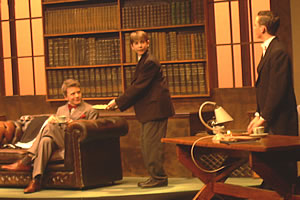
A school play at Harrow ("Another Country")

Independent schools do not receive funds from the government or local authorities. They charge school fees (some scholarships may be available for the brightest pupils or for children from poorer families: see below). The schools select pupils according to ability by using an entrance exam. Schools are often single-sex boys schools or girls schools, although many boys schools accept girls in the sixth form (between the ages of 16 and 18). Many of the schools accept a mixture of full boarders (who live in the school grounds during term-time), weekly boarders (who return home only at weekends) and dayboys/daygirls (who return home each evening), but some are only for day pupils.

A preparatory school (usually called a prep school) is a school to prepare pupils to go to a public school. Boys often enter such schools aged about 8 and girls aged about 11. The entrance exams used by most public schools are known as Common Entrance exams and are taken at the age of 13. Some public schools have their own prep schools as well as the senior school, but students from other prep schools can apply to the senior school. Many prep schools belong to an association known as the Incorporated Association of Preparatory Schools (IAPS): http://www.iaps.org.uk.

A public school is an independent secondary school which is a charity (not profit-making) and which belongs to one of the public school associations, the largest of which are the Headmasters' Conference (HMC) and the Girls' School Association (GSA). The expression "public school" can be confusing: in many countries other than England a "public school" is a school which is run by the government, which is not the case with these schools. In England the term private school is used to refer to any school which is run to make a profit. Among the most famous public schools are Eton, Harrow and Winchester.


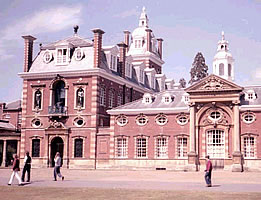
Wellington College (a public school)

If you are a parents who wants to send your children to a UK school should also contact the British Council in your country. To find their website address, see the Links section of this website and select your own country.

Note that children under 18 must have a guardian in the UK while they are studying. If there is no parent, friend or relation living in the UK who will take this responsibility, you will need to use an agency to provide someone suitable.

The accreditation body for independent schools in the UK is known as the Independent Schools Council (ISC). See the website of the Independent Schools Council information service (ISCis): http://www.isis.org.uk. ISC International provides information and assistance to parents from other countries who want to send their children to a UK school: http://www.isis.org.uk/international.

A ranking table - based on A-level exam results at independent schools in the UK in 2004 - is available from this link (it is a PDF file, so you will need Adobe Acrobat to read it): http://www.telegraph.co.uk/news/graphics/2004/08/28/nschool28.pdf

Rankings give you a broad measure of academic performance, but you should not attach importance to the exact order. Ask the schools for their own comments on exam performance. You may need to take account of factors which are not included (for example, some schools allow students to take the International Baccalaureate or vocational A levels). Remember also to consider non-academic factors as well when choosing a school.

Further information about boarding schools can be obtained from the Hobsons Guide to Boarding Schools: http://www.boardingschools.hobsons.com.
Also, see the Emetis Private School Guide: http://www.emetis.com.

Guide to UK Boarding Schools 2005
Publisher: Hobsons
Date: December 2004
Boarding Schools and Colleges
Editors: Derek Bingham, Catherine Travers
Publisher: John Catt Educational
Date: March 2004
Guide to Independent Schools
Authors: Klaus Boehm, Jenny Lees-Spalding
Publisher: Trotman
Date: November 2004
The Independent Schools Guide 2005/2006
Author: Gabbitas Educational Consultants
Publisher: Kogan Page
Date: February 2005
International Schools: The Authoritative Guide to International Education
Editor: Catherine Travers
Publisher: John Catt Educational
Date: October 2004
 

- (b) State schools

There are several state boarding schools in the UK. These can only be attended by UK nationals, nationals of another EU member country or those with a right to residence in the UK. The education is provided free, but parents must pay for the cost of boarding. Most of these schools are mixed sex (some are single sex), and they usually cater for students between the ages of 11 and 18 (some take students from the age of 7, or only up to the age of 16). For further details, see the website of the State Boarding Schools Association: http://www.sbsa.org.uk.

Back to top


SCHOLARSHIPS


For details of scholarships which are available to international students, see the British Council's scholarships database: http://www.educationuk.org/scholarships. You should also ask schools directly what scholarships are available and how to apply.

Back to top


ETON COLLEGE


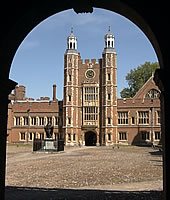
Perhaps the most famous public school in the UK is Eton. It is located near Windsor. It was founded in 1440 by the English king Henry the Sixth (King's College Cambridge was founded in 1441). Lupton's Tower, opposite the main entrance, was built in 1520 by Henry Redman, who was also worked on the palace at Hampton Court.


Lupton's Tower (1520)

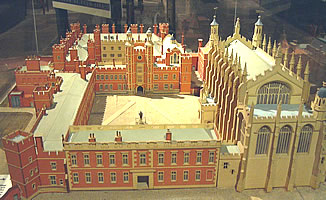
A model of the college

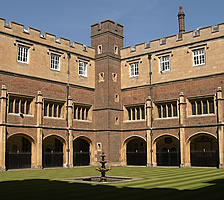
The Cloisters

Entrance to Eton is competitive, based on a test at the age of 11 and a Common Entrance exam at 13. Academic standards are very high. The academic year starts at the end of September and has three terms. The year finishes with the exams in early June. Short courses are run at the college after the boys have left for their summer holidays. There are no girls at Eton (many other boys' public schools in the UK accept some girls in the upper school, after age 16). Boys leave the school at the age of 18 - many go on to study at top universities such as Oxford and Cambridge.


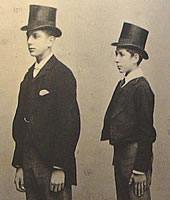
Eton uniform in about 1880
The boys still wear a formal school uniform: a black tailcoat and waistcoat and pin-striped trousers (top hats have not been worn since the 1940s). Students at Eton are all boarders (some other public schools accept dayboys as well). Boys live in dormitories in a "house" (run by a "house master"). They have their own small rooms with a bed and desk. The main team sports which are played are rugby and football in the winter and spring, and either cricket or rowing in the summer. Other popular activities include drama and music. There are daily services in the chapels. Senior boys may take part in military training (in what is called the Combined Cadet Force), or choose to do social service in the community.

Famous "Old Etonians" (people educated at Eton) include the Duke of Wellington, writers such as Shelley and George Orwell, the economist Keynes, and many British Prime Ministers. Both of Prince Charles' sons (William and Harry) studied at Eton (Harry left in June 2003).

For further information about the school, see: http://www.etoncollege.com.
For more photos of Eton and the nearby town of Windsor, see: Travel/Tours/England/Windsor.

Back to top


LINKS


Using an education travel agent: Prepare/Agent
The cost of living in the UK: Prepare/Cost
UK immigration issues: Prepare/Visa

Home page: Home

Back to top

© UK Student Life 2002-2007


* Search this website (www.ukstudentlife.com) or the web:
Google
 
Web www.ukstudentlife.com